5 Mistakes People Make When Designing a Living Wall in the Mediterranean Climate
Updated: Jul 31
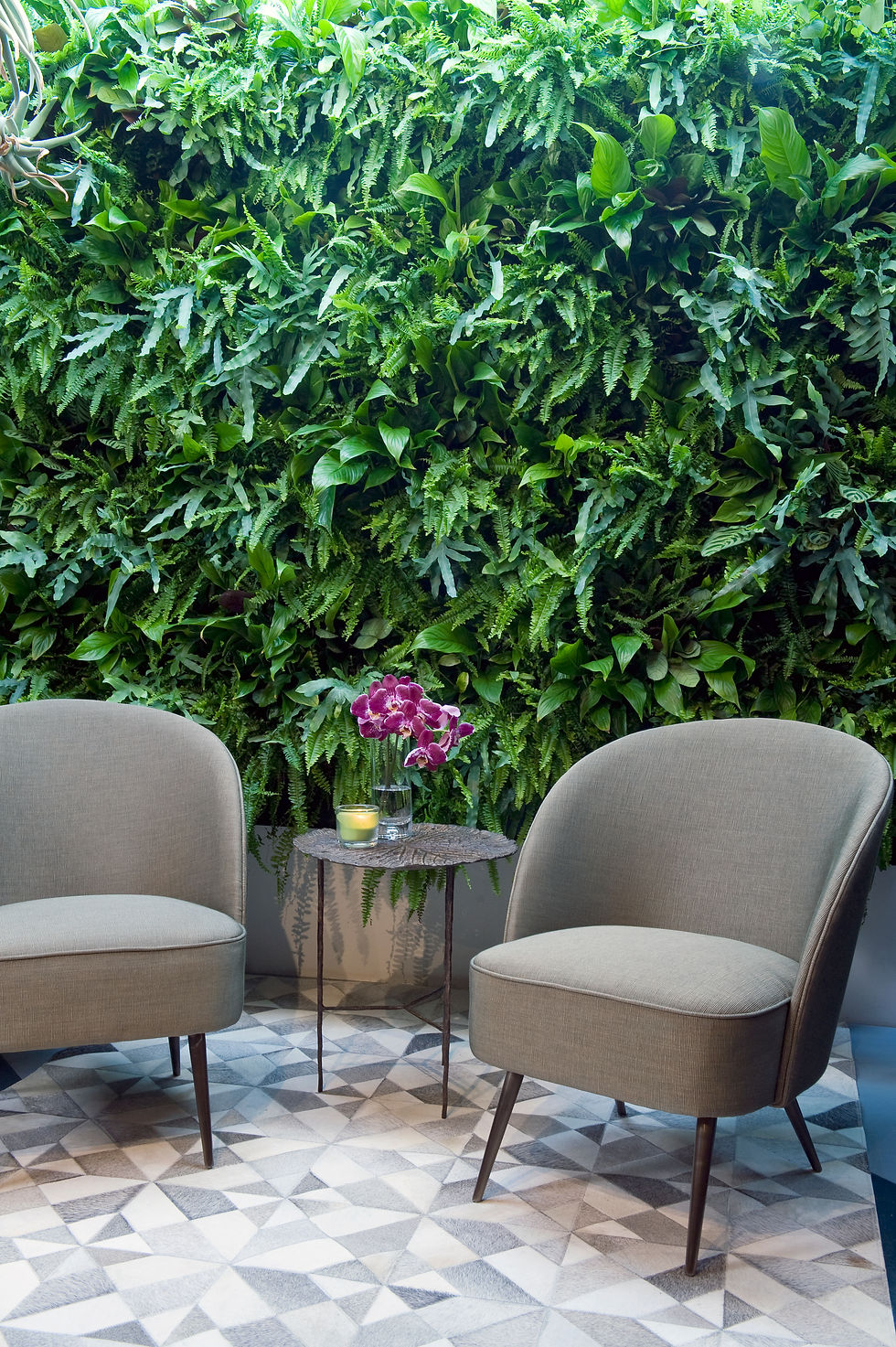
A living wall looks effortless in a Mediterranean interior.
Until it is not.
The light is perfect. The architecture is clean. The space feels elevated.
You imagine adding greenery. Vertical texture. Something alive against stone and sun.
And then it struggles.
Too many vertical planting projects in southern Spain begin with excitement and end with frustration. Watering becomes inconsistent. Maintenance becomes overwhelming. Eventually, the installation is removed.
Living greenery can work here. It fails when design ignores how the Mediterranean climate interacts with indoor space.
If you are considering adding vertical greenery in Andalusia or along the Costa del Sol, these are the mistakes to avoid.
1. Underestimating the Intensity of Mediterranean Light
Mediterranean light is intense.
South-facing interiors can receive prolonged, high-intensity exposure. White walls and stone surfaces often reflect and amplify that light, allowing heat to accumulate gradually throughout the day.
Many installations struggle when plant placement does not match the actual light conditions in the room.
Bright indirect light supports healthy growth.
Direct, prolonged exposure increases plant stress and accelerates moisture loss.
Design must begin with orientation and exposure, not only visual composition.
2. Ignoring Moisture Stability in Mediterranean Summers
In Mediterranean climates, the challenge is not simply watering.
It is maintaining a stable root environment despite climate fluctuation.
Strong sunlight increases evaporation. Air conditioning lowers indoor humidity. Interiors heat up during the day and cool at night. These shifts create stress inside the planting system.
Even systems with built-in reservoirs still require consistent refilling. When watering becomes irregular, moisture levels fluctuate quickly and plant stress increases.
Over time, that instability weakens plants.
Stability is not achieved by watering more.
It is achieved through controlled hydration, appropriate plant selection and thoughtful placement.
In southern Spain, resilience depends on balance.
3. Designing at a Scale That Becomes a Burden
A full architectural green installation is visually powerful.
But scale increases complexity.
Large systems require:
Irrigation infrastructure
Drainage planning
Ongoing technical oversight
In commercial projects, that may be justified. In private Mediterranean homes, it can quickly feel excessive.
When maintenance becomes demanding, enthusiasm fades.
Complexity, not climate, is often what defeats the project.
4. Assuming What Worked Back Home Will Work Here
Southern Spain attracts residents from Norway, Sweden, Denmark, the Netherlands, Germany, the UK, the United States and beyond. Many arrive with plant experience.
But what thrives in cooler climates does not always respond the same way under Mediterranean light and seasonal dryness. Strong sun, reflective surfaces and air conditioning create a different indoor environment.
Not every lush tropical species adapts well to those conditions. Some varieties are simply more resilient and better suited to southern interiors.
Designing for Mediterranean interiors means choosing plants that tolerate:
Strong light
Seasonal dryness
Interior airflow
Temperature fluctuation
Not every plant adapts well to the confined root space typical in vertical planting systems. Choosing compact, resilient species is essential for long-term stability. Selecting adaptable varieties dramatically increases long-term balance and reduces maintenance stress.
A living plant installation is not only a visual feature. It is a living element that responds to its environment.
5. Focusing Only on Installation, Not Long-Term Experience
Many projects focus on how a vertical plant feature looks on day one. Few consider how it will feel after six months. Over time, uneven growth or plant loss can disrupt the visual balance of the composition if the planting scheme is not designed for long-term maintenance.
Will watering remain manageable?
Will the system stay balanced in peak summer?
Will maintenance align with your lifestyle?
When those questions are ignored, frustration grows. This is often when people begin questioning whether a living installation is the right choice at all.
If you are currently weighing that decision, you may find this helpful:
Because the choice is not only aesthetic.
It is about experience over time.
The Smarter Approach for Mediterranean Homes
The Mediterranean climate is not the obstacle. Poor proportion and uncontrolled systems are. Instead of turning vertical greenery into a construction project, introduce it in a contained, controlled format that works with both the climate and the space. A self-watering living plant frame is one of the easiest ways to bring real plants into modern interiors.
Modular framed living plant systems offer:
Defined planting zones
Stabilized hydration
Architectural structure
Scalable composition
You gain the atmosphere of a living wall without the operational burden of a full living wall installation.
In light-rich regions like the Costa del Sol, this balance matters.
When proportion, plant selection and hydration are controlled, living greenery does not struggle. It integrates. And when it integrates, it genuinely transforms the space.

Planning a project? See our architect resources →
Bring Living Design Into Your Interior
Discover framed living design for modern interiors, or request a tailored installation for your space.
Real plants. Clean design. No daily maintenance.


Comments