How to Decide Between a Living Wall and an Artificial Green Wall for Modern Interiors
Updated: Jul 31

What Modern Interiors Were Missing
For years, modern interiors leaned toward restraint. Clean lines, neutral palettes and architectural discipline defined the aesthetic. Minimalism refined our spaces by removing excess and elevating proportion, light and materiality.
As interiors became more precise, however, something became clear. Precision alone does not create atmosphere. A perfectly composed room can still feel emotionally flat or distant. This is where plants began to shift from decorative accessories to meaningful design elements. Instead of simply filling corners, greenery started shaping how a space feels.
And once greenery becomes part of the design language itself, a more important question emerges: Should that green be artificial, or should it be alive?
The Rise of Intentional Green Design
Plants were never absent from interior design. What changed was their scale and integration. Instead of sitting in small pots, greenery began to move onto vertical surfaces.
Living texture replaced empty planes. Designers began thinking not only about composition, but about wellbeing and sensory experience.
This evolution aligns with biophilic design. At its core, biophilic design recognizes a simple truth: humans are biologically wired to respond to nature. Natural elements do not merely decorate a room. They influence perception, comfort and cognitive restoration.
Greenery in modern interiors is no longer an afterthought.
It is structural. Intentional. Essential.
Why Artificial Green Walls Became Popular
When deciding between a living wall and an artificial green wall, artificial options often appear practical because they offer control.
No watering
No growth
No unpredictability
No maintenance risk
They remain visually identical over time. For commercial interiors, that predictability feels reassuring. High quality artificial greenery can look convincing at first glance. In photographs, it performs well.
But what looks impressive in an image can feel lifeless in reality. The eye may accept it. The nervous system does not.
Modern interior design increasingly prioritizes lived experience over visual staging. A self-watering living plant frame is one of the easiest ways to bring real plants into modern interiors.
The Psychology of Real vs Artificial Nature
Environmental psychology does not treat natural elements as decoration. It treats them as stimuli.
Research shows that exposure to real plants can reduce stress markers, support attention recovery and improve perceived wellbeing in indoor environments.
Living systems introduce subtle variability:
Movement in air currents
Micro changes in light reflection
Organic asymmetry
Natural sound absorption that reduces noise
Our perceptual systems are highly sensitive to these cues. Even when we do not consciously analyze them, our bodies register them.
Artificial plants copy the shape, but not the behavior. A synthetic leaf does not respond to light. It does not grow. It does not change. Over time, the brain categorizes it as static background.
A living plant installation remains dynamic. It interacts with the environment and, by extension, with us. That dynamic quality creates depth that cannot be manufactured.
In minimalist and luxury residential design, where materials are carefully selected, this difference becomes increasingly visible and increasingly felt.

The Environmental Question We Can No Longer Ignore
This choice is not only aesthetic. It is material.
Most artificial green walls are manufactured from plastic-based materials derived from fossil fuels. They are rarely recycled in practice and are often replaced when trends shift.
Sustainable home decor is no longer niche. Environmental responsibility increasingly shapes material choices in modern interiors. Choosing a living plant system is not only aesthetic. It is material responsibility. Real plants absorb carbon dioxide, contribute to indoor humidity balance and evolve naturally over time.
Artificial greenery remains static and ultimately becomes waste.
This is not about judgment.
It is about alignment.
If a space reflects sustainability and long-term thinking, its materials should reflect those values.
But What About Maintenance?
This is where hesitation appears.
Large structural living installations can require irrigation systems and ongoing service contracts. That level of complexity is not suitable for every home. In warmer regions, climate adds another layer of complexity. If you are designing in southern Spain, read 👉 5 Mistakes People Make When Designing a Living Wall in the Mediterranean Climate.
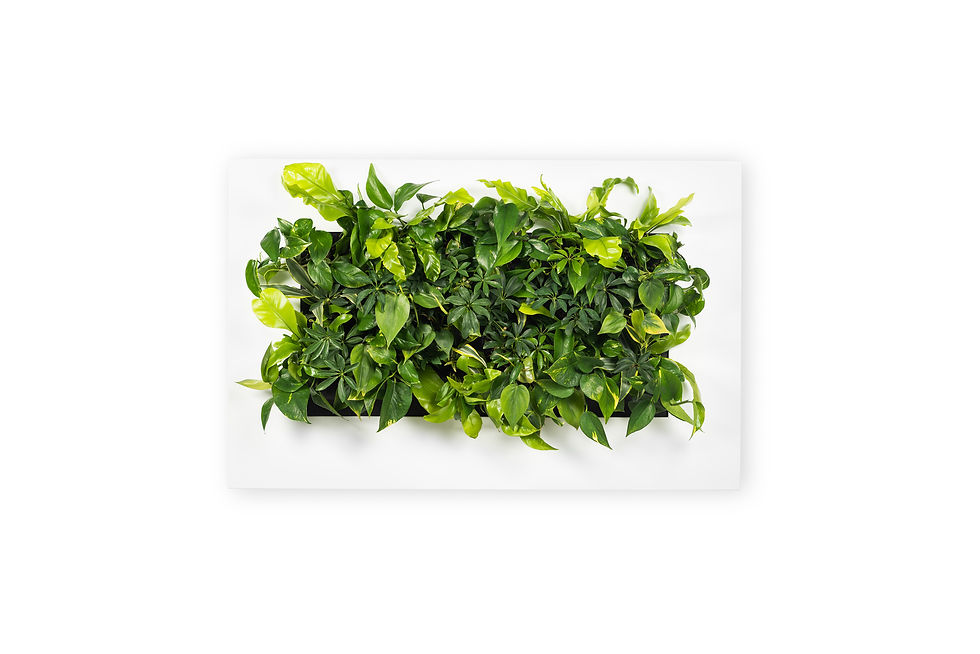
This is where modular framed living plant systems offer a solution.
A framed living plant installation offers:
A contained and balanced planting system
Built-in self-watering that reduces daily care
Clean proportions that fit modern interiors
Flexibility to scale from one frame to a full composition
Instead of constructing a full vertical garden, you introduce a contained living element.
It delivers the atmosphere of a living wall without turning the space into an infrastructure project.
For modern interiors in Spain, especially in light-rich regions like the Costa del Sol, framed systems offer a practical and elegant balance.
Which One Truly Belongs in a Modern Interior?
Artificial greenery offers convenience.
Living greenery offers presence.
(If you are working with limited square meters, you may also explore 👉 5 Smart Ways to Integrate Botanical Art in Small Spaces.)
One decorates a surface.
The other transforms a space.
When deciding between a living wall and an artificial green wall, the real question is not what looks good on day one. It is what you want to experience every day.
If authenticity, sustainability and atmosphere matter in your interior design decisions, living systems offer a deeper solution.
Modern design is not only about appearance.
It is about how a space feels to live in.

Sourcing for a client? See our interior designer resources →
Bring Living Design Into Your Interior
Explore the Flora Frame collection or request a custom installation.
Real plants. Clean design. No daily maintenance.


Comments