Best Plants for Living Walls on the Costa del Sol (And Which Ones Won't Survive)
Most living wall plant lists are written for a climate that doesn't really exist here, and for pockets that are bigger than what most modular living walls actually have. A plant that looks lush in a general plant guide can genuinely struggle on a south-facing wall in Marbella in August, and a plant with a big root system simply won't hold on in the small individual pockets a modular living wall installation is built from. Plant selection is one of the questions we are asked most once someone decides they want a living wall.
Why Plant Choice Is Harder Here Than It Looks
The best plant for a living wall is not simply the one that tolerates heat. It also has to suit the growing system itself.
First, the climate: long stretches of intense summer UV, very little summer rain, and mild, wet winters, which is close to the opposite of the gentler, cloudier conditions most general plant guides are written around. A plant labelled as suitable for "full sun" in a milder climate is being judged against much gentler conditions than a south-facing wall on the Costa del Sol experiences in July.
Second, and just as important: living walls hold plants in small individual pockets or cassettes, not garden beds. That rules out anything with a large, spreading root system or a heavy mature size, even if it would otherwise tolerate the light and heat perfectly well, and it's one of the most common design mistakes we see on living walls in this climate. The right plant for a living wall has to work on both counts at once.
Indoor Living Walls: A Reliable, Pocket-Friendly Palette
Indoors, climate stops being the deciding factor since temperature and light stay fairly consistent regardless of location, so the winning plants here are really about what performs well in a small pocket long-term.
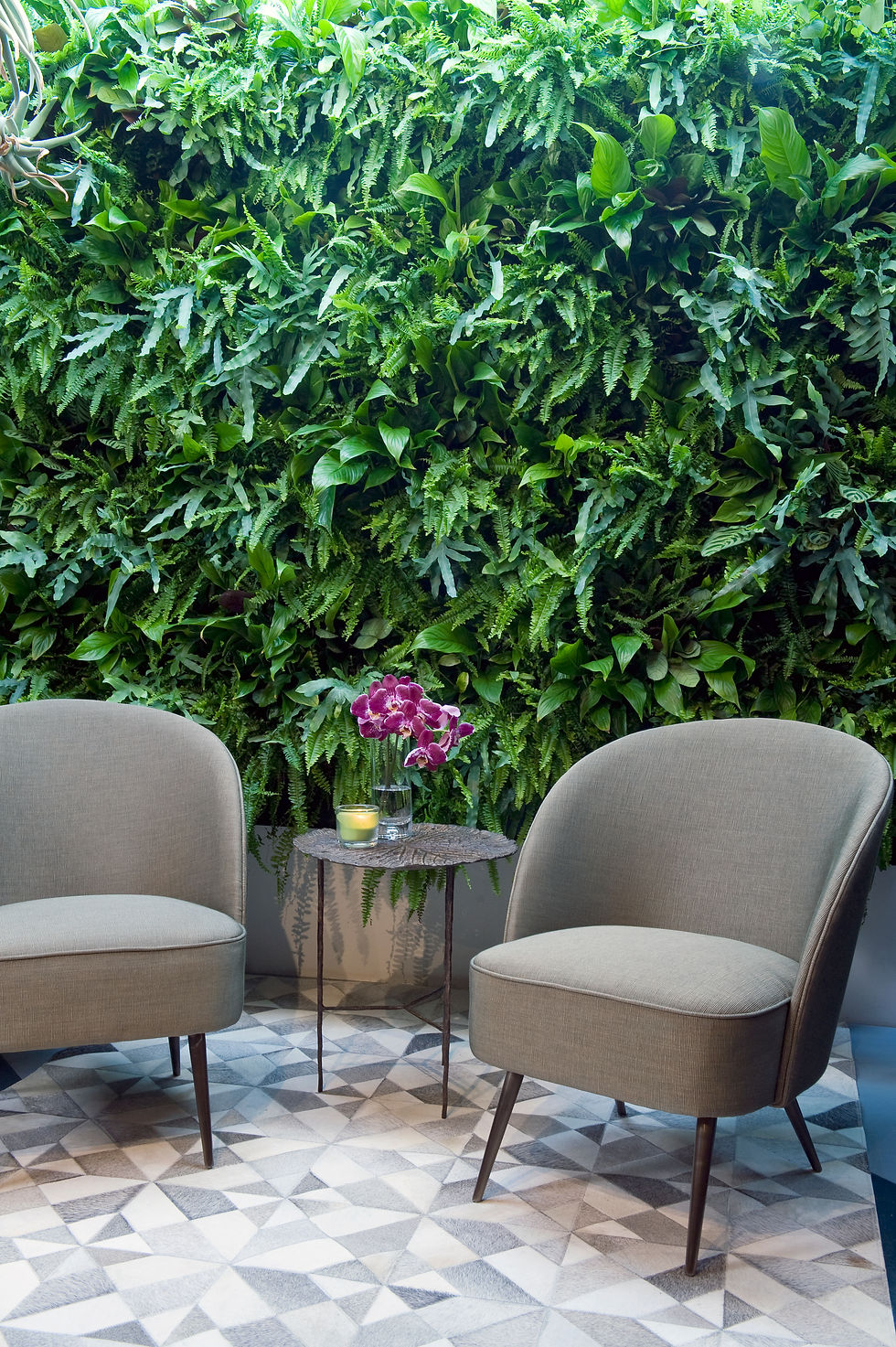
Pothos (Epipremnum aureum) is close to the standard answer for a reason: it trails beautifully, tolerates a wide range of light, and its root system stays compact and manageable in a shallow pocket for years. Heartleaf philodendron (Philodendron hederaceum) behaves almost identically and pairs well alongside it. Peperomia varieties, Chlorophytum comosum (spider plant), Fittonia, and compact ferns like Nephrolepis round out a palette that fills in fast, looks varied, and doesn't outgrow its space. Larger aroids like Monstera are best left out of pocket-style living walls altogether; they're better suited to a floor pot than a wall pocket, since their root systems and mature leaf size are simply too much for the space.
Outdoor Living Walls: Where Orientation Decides Everything
Outdoors, the single biggest factor isn't the plant, it's which way the wall faces. Choosing plants based on orientation rather than appearance is one of the simplest ways to create a living wall that continues to thrive year after year. Fortunately, many of the plants that naturally suit small pockets are also compact Mediterranean species with shallow root systems.
The following plants are widely used in modular living wall systems and are well suited to the Mediterranean climate of the Costa del Sol. The final plant selection should always be based on the wall's orientation, light levels and the specific living wall system being used.
South and west-facing walls (full, intense sun)
This is the toughest exposure on the coast, so it calls for genuinely drought-tolerant, compact Mediterranean plants. Suitable choices include:
Trailing rosemary (Rosmarinus officinalis 'Prostratus')
Dwarf lavender varieties such as 'Hidcote'
Santolina (Santolina chamaecyparissus)
Blue fescue (Festuca glauca)
Sedums
All of these are naturally shallow-rooted and compact, making them well suited to both the intense Mediterranean sun and the limited root space of a modular living wall.
North-facing and shaded or courtyard walls
These locations provide a gentler environment where plants that prefer lower light levels can thrive. Suitable choices include:
Compact ferns such as Nephrolepis and Asplenium
Heuchera
Liriope (Liriope muscari)
Carex species
Polystichum ferns
These species stay relatively compact and have modest root systems, making them well suited to pocket-style living wall systems.
East-facing walls (gentler morning sun)
East-facing walls offer a useful middle ground, receiving gentle morning sun while avoiding the harshest afternoon heat. Suitable choices include:
Carex morrowii
Carex oshimensis
Liriope muscari
Ophiopogon japonicus
Hardy geraniums such as 'Rozanne'
These plants perform well in softer light while remaining compact enough for modular living wall pockets.
Costal exposure
The Costa del Sol is not only defined by sunshine. Coastal properties may also be exposed to salt spray and strong winds, both of which can affect species that perform perfectly well further inland.

Watering: Manual Works Fine for Smaller Walls
It's worth saying clearly: you don't need an automated irrigation system to have a healthy living wall. Manual watering works perfectly well for smaller installations, especially ones at a height you can comfortably reach with a watering can or hose, and it's the simplest option with nothing extra to install or maintain. For larger walls, taller facades, or anything harder to reach, an automated drip system with nutrient dosing makes life a lot easier, and it's worth planning the water, electrical, and drainage connections at the design stage rather than adding them later. Either way, matching the plant to its actual light exposure matters more for long-term health than which watering method you choose.
Getting It Right From the Start
We look at wall orientation, sun exposure, pocket size, and whether it's an indoor or outdoor installation before recommending a plant palette, and for specific projects we also work with local nurseries who know how particular varieties perform in this exact microclimate season to season. Ultimately, no online plant list can replace seeing what is already thriving on similar living walls in the same microclimate. That practical experience is what shapes our recommendations.
Plant | Indoor | Outdoor | Full Sun | Shade | Modular System |
Pothos | ✓ | – | – | ✓ | ✓ |
Spider Plant | ✓ | – | – | ✓ | ✓ |
Sedum | – | ✓ | ✓ | – | ✓ |
Lavender | – | ✓ | ✓ | – | ✓ |
Festuca | – | ✓ | ✓ | Partial | ✓ |
Plants to Avoid in Modular Living Walls
Some plants simply are not suited to the restricted root space of a modular living wall, even if they thrive elsewhere in the garden. Common examples include:
Monstera deliciosa – develops a large root system and oversized leaves that quickly outgrow individual pockets.
Bird of Paradise (Strelitzia reginae) – becomes too large and requires more root space than a modular system can provide.
Large Ficus species – eventually become woody, heavy and difficult to manage in confined planting pockets.
Agapanthus – performs well in the ground but does not adapt well to the limited root volume of most living wall systems.
Climbing wisteria (Wisteria sinensis) – develops vigorous woody stems and an extensive root system that make it unsuitable for modular living wall systems.
Ultimately, a successful living wall is not about choosing the most impressive individual plants. It is about selecting species that stay healthy, balanced and proportionate within the system for many years.
FAQ
Can I put a big leafy plant like a Monstera in a living wall?
Not really, not in a pocket-style system. Its root system and mature size need more room than a wall pocket provides. It's much happier in a floor pot near the wall than in the wall itself.
Do living walls need automated irrigation to survive?
No. Manual watering works well for smaller, easily reachable walls. Automated drip irrigation is mainly a convenience for larger or harder-to-reach installations, not a requirement for plant health.
What plants work best on a south-facing living wall on the Costa del Sol?
Compact, drought-tolerant Mediterranean species like trailing rosemary, dwarf lavender, Santolina, Festuca glauca, and sedums handle full, intense sun far better than general shade-leaning plant lists.
Do shaded living walls need different plants than sunny ones?
Yes. Compact ferns, Heuchera, Bergenia, and Tiarella all do very well on shaded or north-facing walls, since that's a much gentler environment than a south-facing one.
What is the best all-round plant for an indoor living wall?
Pothos, for most cases. It tolerates a wide range of light, trails attractively, and its compact root system holds up in a small pocket for years without becoming a problem.
Ready to Plan the Right Plants for Your Living Wall?
Tell us about your wall's orientation and location and we'll recommend a plant palette that will actually thrive.


Comments