What Is Biophilic Design and Why Is Everyone Talking About It?
Updated: Sep 3

Biophilic design is one of the fastest-growing movements in modern architecture and interior design. From luxury hotels and residential developments to offices, healthcare facilities, and public spaces, designers are increasingly looking for ways to reconnect people with nature.
The idea is simple: humans evolved in natural environments, and we tend to feel better when elements of nature are integrated into the spaces where we live, work, and relax.
This growing understanding has made biophilic design a major influence on architecture, workplace design, hospitality projects, and urban development around the world.
But what exactly is biophilic design, where did it come from, and why is everyone suddenly talking about it?
What Is Biophilic Design?
Biophilic design is an approach to architecture and interior design that seeks to strengthen the connection between people and nature within the built environment.
The term comes from the concept of biophilia, which describes humanity's innate tendency to seek connections with nature and other living systems.
Rather than treating nature as something that exists outside our buildings, biophilic design integrates natural elements into the places where we live, work, learn, and relax.
Examples include:
Living walls and vertical gardens
Indoor plants and planting schemes
Natural daylight
Views of greenery
Natural materials such as wood and stone
Water features
Outdoor terraces and green roofs
The goal is not decoration.
The goal is to create environments that support human wellbeing by reconnecting people with nature.
Where Did the Idea of Biophilia Come From?
The term biophilia was first used by psychoanalyst Erich Fromm in the 1960s. However, it became widely known through the work of biologist Edward O. Wilson.
In his 1984 book Biophilia, Wilson proposed that humans possess an innate affinity for nature because our species evolved within natural environments for hundreds of thousands of years.
For almost all of human history, forests, rivers, plants, animals, and natural landscapes formed the backdrop of daily life.
Modern cities are a very recent development.
According to the biophilia hypothesis, our brains still respond positively to many of the environmental conditions that supported human survival throughout evolution.
This idea has since influenced fields ranging from psychology and healthcare to urban planning and architecture.
Why Does Nature Affect Us So Strongly?
Most people intuitively understand the feeling.
A walk through a forest feels different from walking through a concrete parking lot.
A hotel room overlooking trees often feels more relaxing than one overlooking a blank wall.
A workplace with natural light and greenery tends to feel more pleasant than a windowless office.
Research increasingly suggests that these reactions are not simply personal preferences.
Exposure to natural elements has been associated with:
Reduced stress
Improved mood
Better concentration
Enhanced creativity
Faster recovery from mental fatigue
Greater workplace satisfaction
Improved overall wellbeing
While plants alone are not a cure for stress or burnout, a growing body of research suggests that environments designed with nature in mind can positively influence how people think, feel, and perform.
This helps explain why so many organisations are investing in biophilic design. It is not just about making spaces look better. It is about creating environments where people feel better.
The 4 Big Ideas Behind Biophilic Design
If you start reading about biophilic design, you will quickly discover frameworks, patterns, principles, and academic terminology.
One of the most widely cited frameworks identifies 14 different patterns of biophilic design. While these patterns are useful for architects and designers, they can feel overwhelming to everyone else.
Fortunately, they can be grouped into four simple ideas. These four ideas are often called the elements or principles of biophilic design.
At its core, biophilic design is about helping people reconnect with nature in ways that feel natural, enjoyable, and deeply human.
1. We Want to See Nature 🌿
Humans are naturally drawn to greenery, water, wood and natural landscapes.
This is the most obvious and recognisable aspect of biophilic design.
Examples include:
Living walls
Indoor plants
Courtyards
Green roofs
Water features
Views of gardens, parks, or natural scenery
This explains why a hotel overlooking the sea feels different from one overlooking a parking lot, or why offices with greenery often feel more inviting than those without it.
2. We Want to Feel Nature 🌞
Nature is not only visual.
We experience it through sunlight, airflow, temperature changes, sounds, scents, and seasonal variation.

Biophilic spaces often include:
Natural daylight
Fresh air and ventilation
The sound of moving water
Natural scents
Seasonal planting
Dynamic lighting throughout the day
These subtle experiences help spaces feel alive rather than static.
3. We Are Drawn to Natural Shapes and Materials 🪵
Nature rarely works in straight lines.
Organic forms, natural textures, and authentic materials tend to feel more comfortable and welcoming than sterile environments dominated by synthetic surfaces.

Examples include:
Wood
Stone
Cork
Natural fibres
Curved forms
Nature-inspired patterns and textures
Even when there are no plants present, these elements can strengthen our connection to nature.
4. We Like Spaces That Feel Both Safe and Interesting 🏡
Perhaps the most surprising principle of biophilic design is that humans instinctively seek a balance between security and exploration.
We enjoy spaces that offer:
Clear views of our surroundings
Comfortable places to retreat
A sense of discovery
Moments of surprise and curiosity
Think of a quiet corner in a hotel lounge overlooking a landscaped garden, or a pathway that gradually reveals a beautiful view.
Many of the world's most memorable spaces use this balance without us even noticing.
Together, these four ideas form the foundation of biophilic design.
Whether it is a living wall in a reception area, a rooftop garden, natural materials in a hotel lobby, or a workplace filled with daylight and greenery, the goal remains the same:
To create environments that feel more connected to nature and, ultimately, more connected to the people who use them.
Biophilic Design in the Real World
Biophilic design is not a niche theory discussed only in architecture schools.
Many of the world's most recognised buildings incorporate biophilic principles.
Apple Park in California was designed around extensive green space and walking environments.

Singapore's Changi Airport integrates indoor gardens, water features, and natural light throughout the passenger experience.

The Amazon Spheres in Seattle use thousands of plants to create a workplace environment inspired by nature.

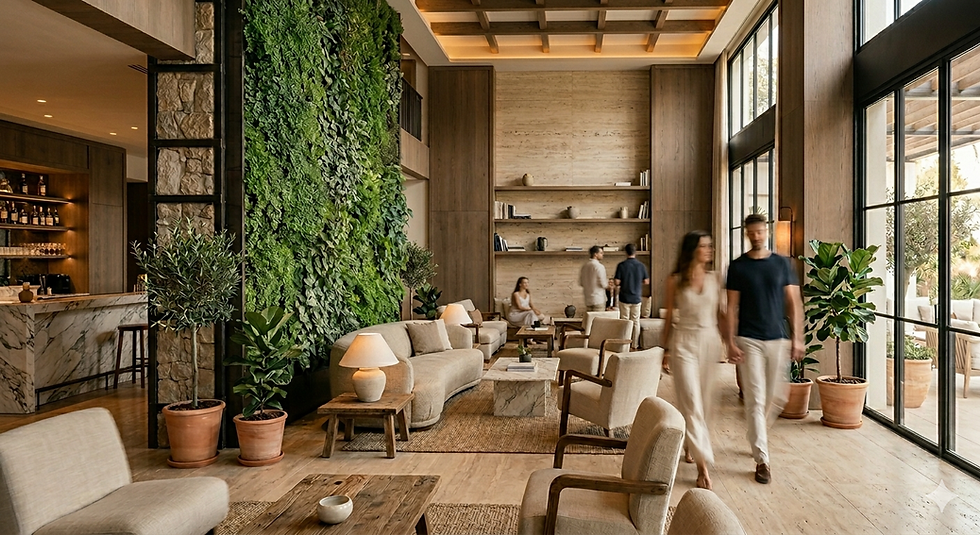
Closer to home, luxury hotels, wellness resorts, residential developments, and office spaces across Spain increasingly use living walls, green roofs, indoor planting, and outdoor living environments to create more desirable and memorable spaces.
Why Architects and Developers Are Embracing Biophilic Design
The rise of biophilic design is not simply about aesthetics.
It reflects changing expectations about how buildings should perform.
Modern developments are increasingly expected to support:
Wellbeing
Sustainability
Employee experience
Resident satisfaction
Hospitality experiences
Environmental performance
As competition increases, developers and designers are looking for ways to create memorable spaces that stand out.
Biophilic design helps achieve this by combining visual appeal with measurable human benefits.
For luxury developments in particular, it has become a powerful way to differentiate projects and create environments that people genuinely enjoy spending time in.
Living Walls and the Rise of Biophilic Design
Among the many tools available to designers, living walls for luxury interiors on the Costa del Sol have become one of the most recognisable expressions of biophilic design.
Unlike traditional decoration, living walls introduce real, living vegetation directly into interior and exterior environments.

They can create visual impact, strengthen connections to nature, support sustainability goals, and transform underused walls into living features.
This is one reason living walls are increasingly appearing in offices, hotels, residential developments, restaurants, and commercial spaces around the world.
In dense urban environments where horizontal space is limited, living walls offer a practical way to introduce nature vertically while creating a distinctive design feature.
Why Biophilic Design Matters More Than Ever
As urban populations continue to grow, people spend an increasing proportion of their lives indoors.
At the same time, awareness of mental wellbeing, sustainability, and quality of life has never been higher.
Biophilic design offers a practical response to these challenges.
It reminds us that even in highly developed environments, people remain connected to nature.
The growing popularity of living walls, green roofs, indoor planting, and nature-inspired architecture reflects a simple idea:
People tend to feel better when nature is part of everyday life.
Biophilic design is not a passing trend.
It is a recognition of something fundamentally human.
FAQ
What is biophilic design, in simple terms?
Biophilic design is an approach to architecture and interior design that brings real elements of nature, like plants, natural light, natural materials, and organic shapes, into the places where people live and work, because humans have an innate need to stay connected to nature.
What are the elements of biophilic design?
The core elements are usually grouped into four ideas: seeing nature (plants, living walls, views of greenery), feeling nature (daylight, fresh air, natural sounds and scents), natural materials and shapes (wood, stone, organic forms), and spaces that feel both safe and interesting (clear views paired with cosy, discoverable corners).
Is biophilic design just about adding plants?
No. Plants are the most visible expression of it, but biophilic design also includes natural light, airflow, natural materials like wood and stone, organic shapes, and how a space is laid out. A living wall is a strong biophilic feature, but it works best alongside these other elements rather than alone.
Does biophilic design only apply to offices, hotels, and public buildings?
Not at all. The same principles apply just as well at home. A living wall, more daylight, natural materials, or a well-placed indoor garden can bring the same wellbeing benefits to a house or apartment as they do to a corporate lobby.
Why is biophilic design important?
Research links exposure to natural elements with reduced stress, improved mood, better concentration, and greater overall wellbeing. As people spend more of their lives indoors, biophilic design offers a practical way to keep that connection to nature intact.
What is a simple example of biophilic design on the Costa del Sol?
A living wall in a villa entrance, hotel lobby, or office reception is one of the clearest local examples: it introduces real greenery, softens hard architectural lines, and creates a natural focal point, all inside a small footprint that suits the region’s modern developments.
Bring the Benefits of Biophilic Design Into Your Home
Create a stronger connection to nature with a professionally designed living wall.
Looking for a smaller solution? Explore Living Plant Frames →


Comments